GST for Travel Agents in India: CGST, SGST, IGST and Place of Supply Explained
CGST and SGST, or IGST? The answer depends on place of supply — and getting it wrong is one of the most common invoice mistakes travel agencies make.
GST is one of the few topics every Indian travel agency owner has an opinion about — and one of the easiest places to make an expensive mistake. This guide covers the basics that show up on every invoice. It is not tax advice: rates and rules change, so always confirm the current position with your chartered accountant.
The three parts of GST on an invoice
- CGST — Central GST
- SGST (or UTGST) — State or Union Territory GST
- IGST — Integrated GST
On a single invoice you charge either CGST + SGST or IGST — never all three.
Which one applies?
It comes down to two questions:
- Where is the supplier? That is your agency's registered location.
- What is the place of supply? That is decided by GST rules for the type of service and the customer.
If the supplier's state and the place of supply are the same state, the sale is intra-state: charge CGST + SGST, split equally.
If they are different states, the sale is inter-state: charge IGST at the full rate.
A simple example
Your agency is registered in Gujarat.
- A client from Ahmedabad books a Kerala package. If the place of supply works out to Gujarat, you charge CGST + SGST.
- A client from Mumbai books the same package. If the place of supply works out to Maharashtra, you charge IGST.
The tricky part is that place-of-supply rules for travel services depend on the type of service (tour packages, accommodation, passenger transport, agent services) and on whether the customer is registered under GST. This is exactly why the place of supply should be recorded on every invoice, not left to memory.
Tour packages versus agent services
Agencies often earn in two different ways:
- As a tour operator — selling a complete package at one price. A specific GST rate and conditions apply to tour operator services.
- As an agent — earning a commission or service fee on a hotel, flight or other component booked on the client's behalf. GST then applies to your fee or commission.
The rate, and whether you can claim input tax credit, can differ between the two. Ask your CA which treatment fits each product you sell, and set it up once in your system so it is applied the same way every time.
Invoice checklist for travel agencies
Every tax invoice should clearly show:
- Your GSTIN, legal name and address
- The customer's name, address and GSTIN (for business clients)
- Place of supply (state name and code)
- The service description and SAC code
- Taxable value
- CGST + SGST or IGST, with rates and amounts
- Invoice number from a consistent series and the invoice date
Common mistakes
- Charging IGST to every out-of-town client without checking the place of supply.
- Quoting "inclusive of GST" and then invoicing GST on top.
- Changing the tax split between the quote and the final invoice.
- Issuing refunds without a matching credit note and ledger entry.
How a CRM helps
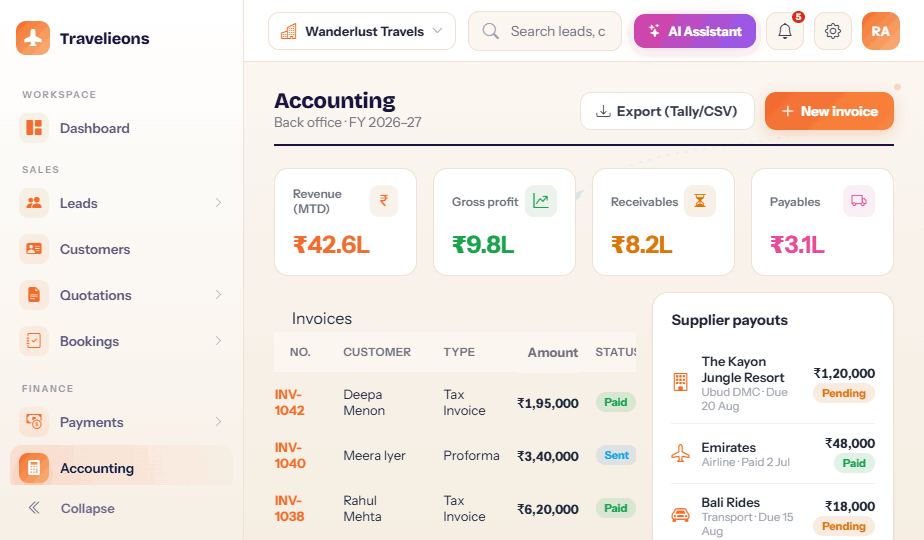
A good travel CRM takes the arithmetic out of human hands. In Travelieons, invoices carry the CGST/SGST or IGST split and place of supply automatically, using the same tax logic as the quotation, and refunds create a proper money-out entry in the ledger. Your CA sees clean, consistent data — and you stop fixing invoices by hand.
See how it works on the features page, or talk to us about your setup.