What Is a Travel CRM? A Plain Guide for Indian Travel Agencies
Spreadsheets, WhatsApp chats and a notebook can run a travel desk — until they cannot. Here is what a travel CRM actually does, and how to tell if your agency needs one.
Most travel agencies in India start the same way: enquiries arrive on WhatsApp and phone, quotes are built in Excel, and payments are tracked in a notebook or a Tally ledger that only one person understands. It works with ten enquiries a week. At fifty, things begin to slip.
A travel CRM (customer relationship management software built for travel) is the system that replaces that patchwork. It keeps the customer, the enquiry, the quotation, the booking and the money in one connected record.
What a travel CRM does
A general CRM tracks contacts and deals. A travel CRM understands trips. That difference shows up everywhere:
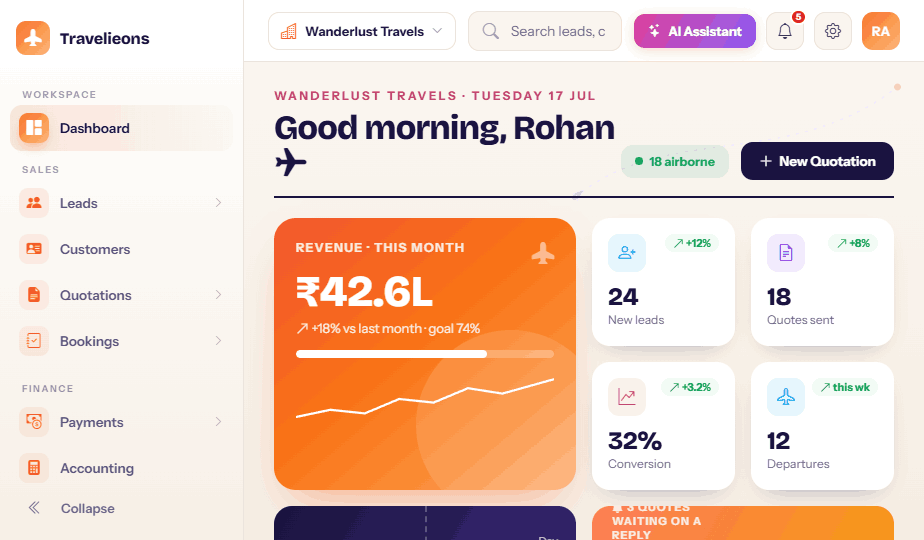
- Leads and pipeline — every enquiry, whatever the source, lands on one board with an owner, a destination, travel dates, pax count and a next follow-up.
- Quotations — hotels, transfers, sightseeing and flights are costed line by line, with markup and GST worked out for you. A sent quote is kept as a version, so you always know what the client actually saw.
- Itineraries — a day-wise plan with photos goes out as a branded PDF or a share link the client can open on a phone.
- Bookings and vouchers — once the client says yes, the quote turns into a booking with supplier confirmations and vouchers.
- Payments and accounts — advance, balance, refunds and supplier dues sit against the booking, not in a separate sheet.
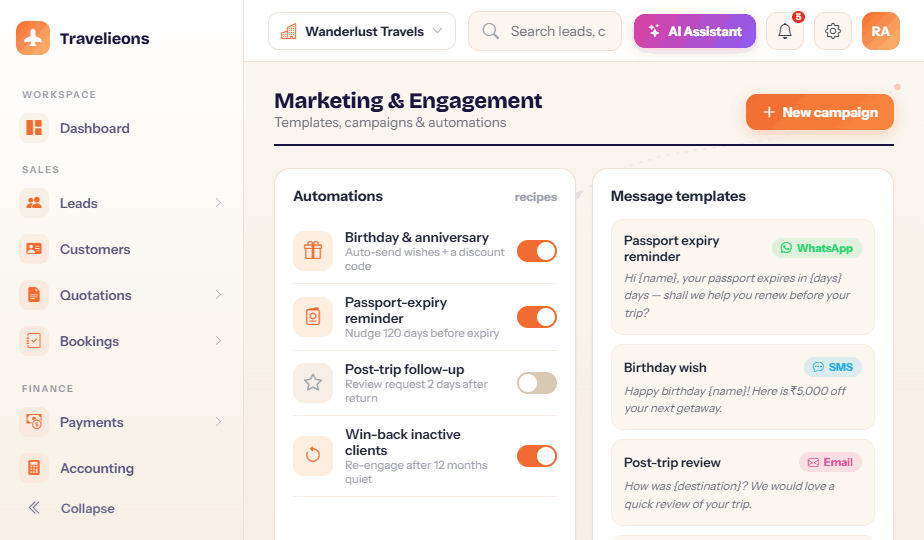
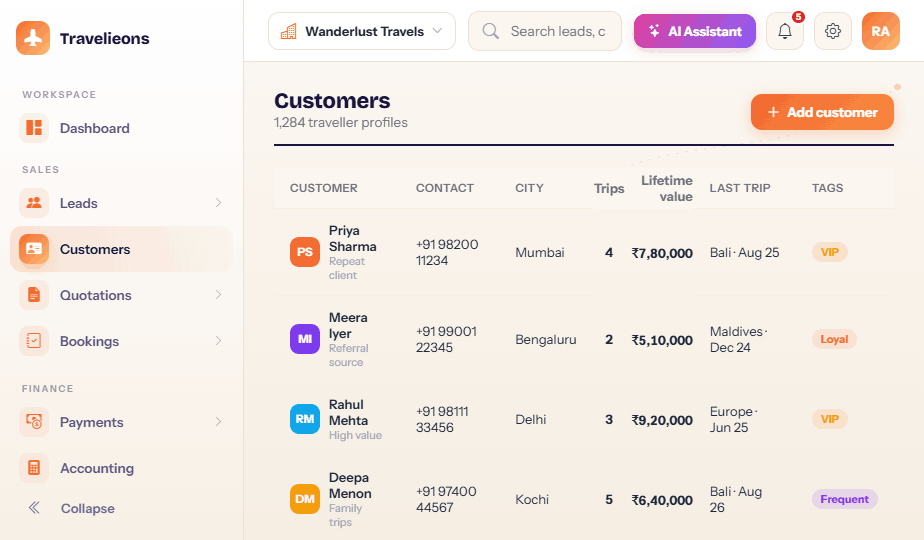
- Travellers and documents — passports, visas and their expiry dates live with the customer, and the system reminds you before they expire.
Signs your agency needs one
You probably need a travel CRM if any of these sound familiar:
- An enquiry was lost because the agent who took it was on leave.
- Two people quoted the same client two different prices.
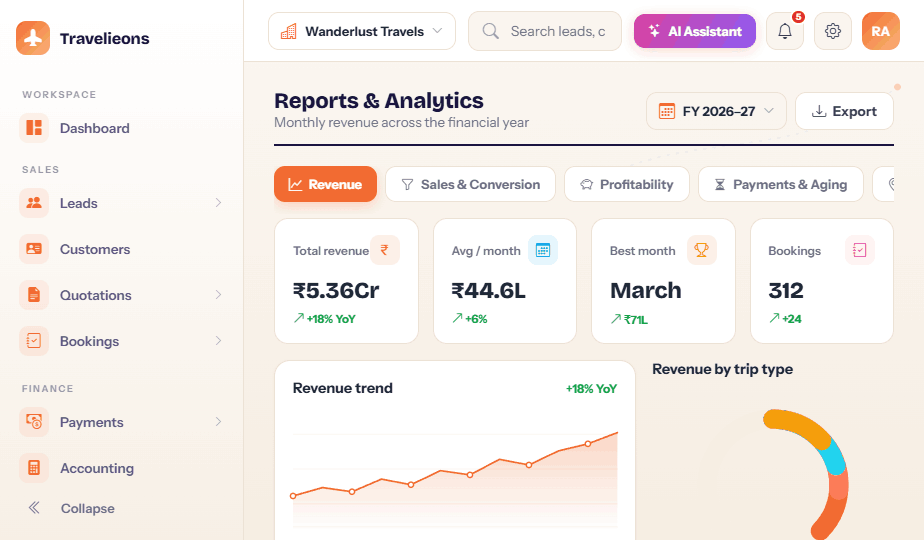
- Nobody can say, without a day of work, how much margin you made last month.
- A client travelled with a passport that was about to expire.
- Your owner spends evenings chasing balance payments over WhatsApp.
None of these are people problems. They are information problems, and software solves information problems well.
What to look for in India
Indian agencies have needs that a generic, foreign CRM rarely covers:
- GST built in — CGST and SGST for intra-state sales, IGST for inter-state, and the right place of supply on every invoice.
- INR first, multi-currency when needed — DMC rates in USD, AED or THB, sold to the client in rupees.
- WhatsApp as a real channel — template messages, quote links and payment reminders sent from the CRM, not copied by hand.
- Net cost protection — sales staff should be able to quote without seeing supplier net rates, if the owner decides so.
- A mobile app — your agents meet clients in person; they need to quote from the phone.
How Travelieons approaches it
Travelieons was built around one idea: one booking record. The enquiry, every version of the quote, the itinerary, the booking, the invoice and each payment all hang off the same record. Nothing is re-typed, so nothing drifts.
If you want to see what that looks like with your own kind of trips, book a short demo or start a free trial. Most agencies are quoting from it within the first week.